A disc herniation, also known as a slipped or ruptured disc, happens when the soft inner part of a spinal disc pushes through its outer layer. This can put pressure on nearby nerves and cause pain, numbness, or weakness in the back, neck, or limbs. It is one of the most common causes of chronic back pain among adults in Brooklyn NY, especially for those who spend long hours sitting, lifting heavy objects, or performing repetitive physical work.
At Back in Motion, our Disc Herniation Treatment in Brooklyn NY focuses on addressing the root cause of the problem rather than only treating the symptoms. Using a combination of chiropractic adjustments, physical therapy, and customized spinal rehabilitation, we help patients relieve pain, restore movement, and strengthen their spine for lasting results.

The spine is made up of bones called vertebrae, separated by discs that act as cushions between them. Each disc has a soft, gel-like center called the nucleus pulposus and a tough outer shell known as the annulus fibrosus. A disc herniation occurs when the inner material pushes out through a weakened part of the outer wall, pressing on nearby nerves.
According to the Cleveland Clinic, a herniated disc is a common spinal problem caused by wear and tear, repetitive strain, or injury to the back (Cleveland Clinic, 2023). It can develop anywhere along the spine but most often affects the lower back (lumbar spine) or neck (cervical spine).
In Brooklyn NY, long hours spent commuting, desk work, or manual labor can contribute to disc issues. People who sit for extended periods, lift heavy loads, or maintain poor posture are especially at risk. Understanding how this condition develops allows for early treatment and prevention of chronic back or neck pain.
The symptoms of a herniated disc can vary depending on where the disc is located and how severely it presses on nearby nerves. Some patients may experience sharp, shooting pain, while others feel stiffness or weakness in the limbs.
Common symptoms include:
Pain in the back, neck, or shoulders that worsens with movement
Pain radiating down the leg or arm
Numbness or tingling in the arms, hands, legs, or feet
Muscle weakness or difficulty lifting objects
Pain that intensifies when sitting, bending, or coughing
In severe cases, patients may also experience limited mobility or balance issues. If left untreated, the condition can progress and lead to long-term nerve irritation. Early intervention through Disc Herniation Treatment in Brooklyn NY can help prevent chronic pain and promote faster recovery.
Living in Brooklyn means balancing work, family, and a fast-paced lifestyle, but back or neck pain from a herniated disc can make even simple activities difficult. From long commutes to hours spent at a desk, the daily strain can worsen symptoms and reduce quality of life.
Office professionals often notice stiffness and aching after long workdays. Manual laborers and construction workers can feel sharp pain when bending or lifting. Parents may find it challenging to carry children, cook, or clean without discomfort. Over time, these limitations can lead to frustration, fatigue, and reduced independence.
Untreated disc herniation can also affect sleep, concentration, and mood. Pain may disrupt rest, leading to irritability or reduced focus at work. At Back in Motion, our in-home Disc Herniation Treatment in Brooklyn NY is designed to relieve pain and restore comfort, allowing patients to stay active in their careers, families, and communities.
Back in Motion takes a holistic and science-based approach to treating disc herniation. We customize every plan based on the patient’s symptoms, lifestyle, and goals, using safe and effective therapies supported by medical research.
Gentle chiropractic adjustments can help reduce pressure on the affected disc, realign the spine, and promote better nerve function. According to research published by the National Center for Biotechnology Information (NCBI), chiropractic care can help manage pain and improve spinal function in patients with lumbar disc herniation (PMC, 2016).
Physical therapy focuses on strengthening the muscles that support the spine and improving flexibility. Specific exercises can reduce inflammation, enhance posture, and prevent recurrence. The Mayo Clinic recommends physical therapy as a primary treatment for herniated discs, helping patients regain strength and mobility without surgery (Mayo Clinic, 2023).
Occupational therapists teach safe body mechanics and ergonomic habits to prevent re-injury. They help patients adapt their work and home environments, whether adjusting a desk setup or modifying lifting techniques.
Spinal decompression therapy gently stretches the spine, reducing pressure on nerves and allowing discs to heal. A clinical study published by PMC found that non-surgical decompression can help relieve pain and increase disc space in patients with herniated discs (PMC, 2022).
Cupping therapy encourages blood flow, reduces muscle stiffness, and supports tissue repair. It is often used alongside physical therapy to improve mobility and reduce pain.
Manual therapy techniques, including joint mobilization and soft tissue manipulation, improve flexibility and relieve tension in the back and neck. These methods complement exercise-based rehabilitation for faster recovery.
If your disc herniation resulted from a work-related injury or car accident, Back in Motion provides documentation and care for workers’ compensation cases. Our team ensures safe, effective recovery while handling the required paperwork for your claim.
Every treatment plan at Back in Motion is designed to relieve pain, restore function, and prevent recurrence through natural, evidence-based methods.
At Back in Motion, we believe that recovery should be personalized, convenient, and grounded in science. Our Disc Herniation Treatment in Brooklyn NY is designed to treat the whole person, not just the symptoms.
Your care begins with a thorough assessment, including posture evaluation, mobility testing, and lifestyle analysis. We identify the underlying cause of your discomfort, whether it is posture, repetitive strain, or injury. From there, we create a tailored plan that includes manual therapy, corrective exercises, and education on prevention.
Because our treatments are offered in-home, you can focus on healing without the stress of traveling or waiting in crowded clinics. Each session is conducted by licensed professionals who adapt your plan as your recovery progresses.
Our methods follow recommendations from leading institutions like the Mayo Clinic and Cleveland Clinic, which emphasize conservative, non-surgical treatments as the first step in managing disc herniation (Cleveland Clinic, 2023).
Patients across Brooklyn, Queens, Staten Island, Hoboken, and Jersey City choose Back in Motion for expert spinal care and personalized attention.
In-home treatments for comfort and convenience
Comprehensive care from chiropractors, physical, and occupational therapists
Customized plans that match your daily lifestyle and recovery goals
Evidence-based treatments supported by leading medical research
Flexible scheduling, available Monday to Saturday, 9 am to 8 pm
From Sheepshead Bay to Brighton Beach, we bring compassionate, high-quality care directly to your doorstep.
Disc herniation can result from aging, repetitive motion, heavy lifting, or trauma. Over time, the spinal discs lose flexibility and become more prone to tearing or bulging.
Yes. Most cases respond well to conservative treatments like physical therapy, chiropractic care, and decompression therapy. Surgery is considered only when non-surgical care does not relieve symptoms.
Recovery time depends on the severity of the herniation and consistency of treatment. Many patients notice improvement within a few weeks, while full recovery may take several months.
Yes. Non-surgical spinal decompression is a gentle, research-supported therapy that helps relieve pressure on nerves and promotes natural healing (PMC, 2022).
Yes. We provide rehabilitation for car accident and workplace-related injuries, including documentation and recovery support. Visit our contact page for more details.
You can receive expert in-home care from Back in Motion, located at 2625 E 14th St #209, Brooklyn, NY 11235. We also serve nearby areas including Queens, Staten Island, Hoboken, and Jersey City. Visit our book appointment page to schedule your consultation.
Living with back or neck pain can interfere with every part of your life, but effective treatment is within reach. With Disc Herniation Treatment in Brooklyn NY from Back in Motion, you can relieve pain, regain strength, and get back to the activities you love.
Our dedicated team of chiropractors, physical therapists, and rehabilitation specialists provide in-home, patient-centered care designed for long-term results. We focus on improving your movement, reducing discomfort, and helping you maintain a healthy spine for years to come.
Contact us today to schedule your consultation in Brooklyn NY and take the first step toward recovery. Visit Back in Motion to learn more or book your appointment.
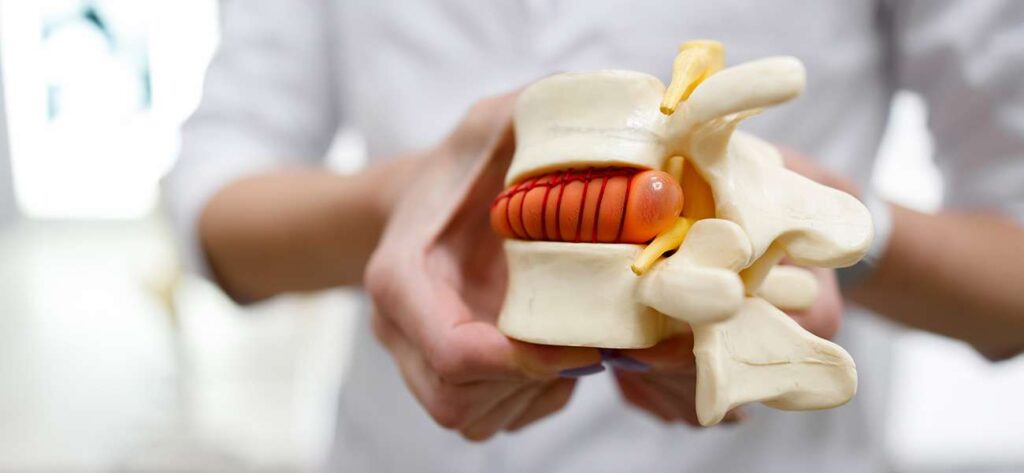
The spinal column consists of a series of bones known as the vertebras stacked onto each other.
Starting from the upper portion of the spinal column, there are:
The lower portion of the spinal column has the sacrum and the coccyx at the base.
To cushion the impact of these structures, every two bones are separated by a disc that absorbs shocks from daily activities (e.g., walking, twisting, lifting objects).
Each disc has two parts:
When an injury occurs in the outer ring of the disc, the inner portion may protrude or swell up, leading to a condition known as a herniated disc.
On this page, we will discuss the causes, symptoms, types, diagnosis, and treatment options for a disc herniation.
According to the American Association of Neurological Surgeons, the prevalence of low back pain in the American population is 75-85%.
The incidence of disc herniation is 2% of the US population. That means more than 6 million Americans seek medical help every year for disc herniation.
These statistics should give you a glimpse of just how common this injury might be.
Disc herniation occurs when the inner portion of the disc goes through the outer ring due to weakness or tearing.
Note that disc herniations are more common in elderly individuals; however, it can occur at any age!
Researchers identified certain motions that increase the risk of disc herniations, including twisting or turning to lift an object. Additionally, lifting very heavy objects applies substantial pressure on your lower back, which may predispose you to a disc herniation.
Interestingly, researchers noted that certain physically-demanding jobs may increase the risk of intervertebral disc damage.
Other risk factors for Disc Herniations include:
Obesity – Overweight individuals are at a greater risk of developing disc herniation due to the added pressure on the discs.
Sedentary lifestyle – Sedentary lifestyle will inevitably lead to weak core and back muscles. As a result, you will be prone to developing disc herniations after sudden movements.
To improve the efficiency of disc herniation management, experts divided this condition into several types:
Posterolateral Herniation – as the name implies, the protrusion in this type occurs in the back and lateral side (45 degree angle to the back) of the vertebral canal. Consequently, the lower nerves get compressed, which presents with a variety of signs and symptoms.
Posterior Herniation – this type of herniation is less frequent. The site of the protrusion is posterior (i.e., the back of the disc). If the protrusion occurs above the 2nd lumbar vertebra, it may lead to the compression of the spinal cord or Cauda Equina syndrome.
Lateral herniation – the most commonly involved disc is L4. The compression occurs above the level of the herniation.
Due to the various discs affected by this condition, the signs and symptoms vary from one patient to another. The lower back is by far the most affected region by slipped discs.
Here are the common signs and symptoms of disc herniation:
The treatment options for disc herniations are diverse and include:
Chiropractic care is indispensable for treating disc herniation. This modality focuses on the following elements:
Most physicians recommend chiropractic care to restore the functional and neurological deficits associated with disc herniation.
It is superior to surgery and medical therapy since it improves the prognosis of patients without exposing them to the side effects of drugs or the complications of surgeries.
In fact, several studies found that spine clinics provide excellent care for patients with damaged discs relative to other treatment modalities. Nerves passing through the vertebral column shouldn’t be obstructed. When a disc herniate, buldges, or protrudes, it may push on the nerves in the spinal colum. Consequently, the symptoms of the patient with a disc buldge are generally milder than in the case of a herniated disc.
Experts recommend sticking with chiropractic care in the case where a herniated disc is not severe.
You need to keep in mind that working with a Chiropractor is essential since you want to work with someone who knows what he/she’s doing and is specifically specialized in treating disc herniations.
Unfortunately, surgery carries several adverse effects that could compromise several functional aspects of your life in the future. However, if all treatment fails, surgery might is necessary in some cases as a last resort. Chiropractic care remains the most effective treatment to relieve pain and restore functionality.
Acute cases of disc herniations that present with severe pain may requires medical management.
Selective nerve root block and epidural injections (i.e., inside the spinal cord) are second-line modalities for disabling pain.
Surgery is the last resort treatment for disc herniation.
Common procedures include laminectomies with discectomies and microdiscectomies.
Other treatments include:
Disc herniation is a very common condition that affects millions of people around the world. Treating a herniated disc is a multistep process that involves medical and surgical treatments, as well as Chiropractic care.
We hope that this article managed to highlight the causes, symptoms, and treatments of disc herniation.
If you still have any questions, concerns, or anything that you want to add to to this page, please don’t hesitate to share your thoughts on the contact us page.
Welcome to Back in Motion Group, your families trusted company when it comes to Health Care. We offer Chiropractic, Physical Therapy, Occupational Therapy, and Speech Pathologists from the comfort of your home in!